

Beloved brother clergy, dear faithful in Christ,
“Behold, how good and how pleasant it is for brethren to dwell together in unity” (Psalm 133:1).
This evening, as we gather in prayer at the beginning of this blessed Pan-Orthodox cycle of services in Windsor-Essex, our hearts are filled with gratitude to God. We stand together—Serbian, Greek, Romanian, Arab, Macedonian, and Canadian Orthodox—speaking different languages, coming from different lands, yet confessing one and the same faith, receiving the same Eucharist, and glorifying the same Holy Trinity: Father, Son, and Holy Spirit.
It is no coincidence that this common prayer begins on the radiant feast we celebrate today: the Sunday of Orthodoxy. For this feast proclaims not only the restoration of the holy icons in the Church, but the triumph of the Orthodox faith itself—the victory of truth over falsehood, of unity over division, of the living tradition of the Church over every attempt to fragment or dilute it.
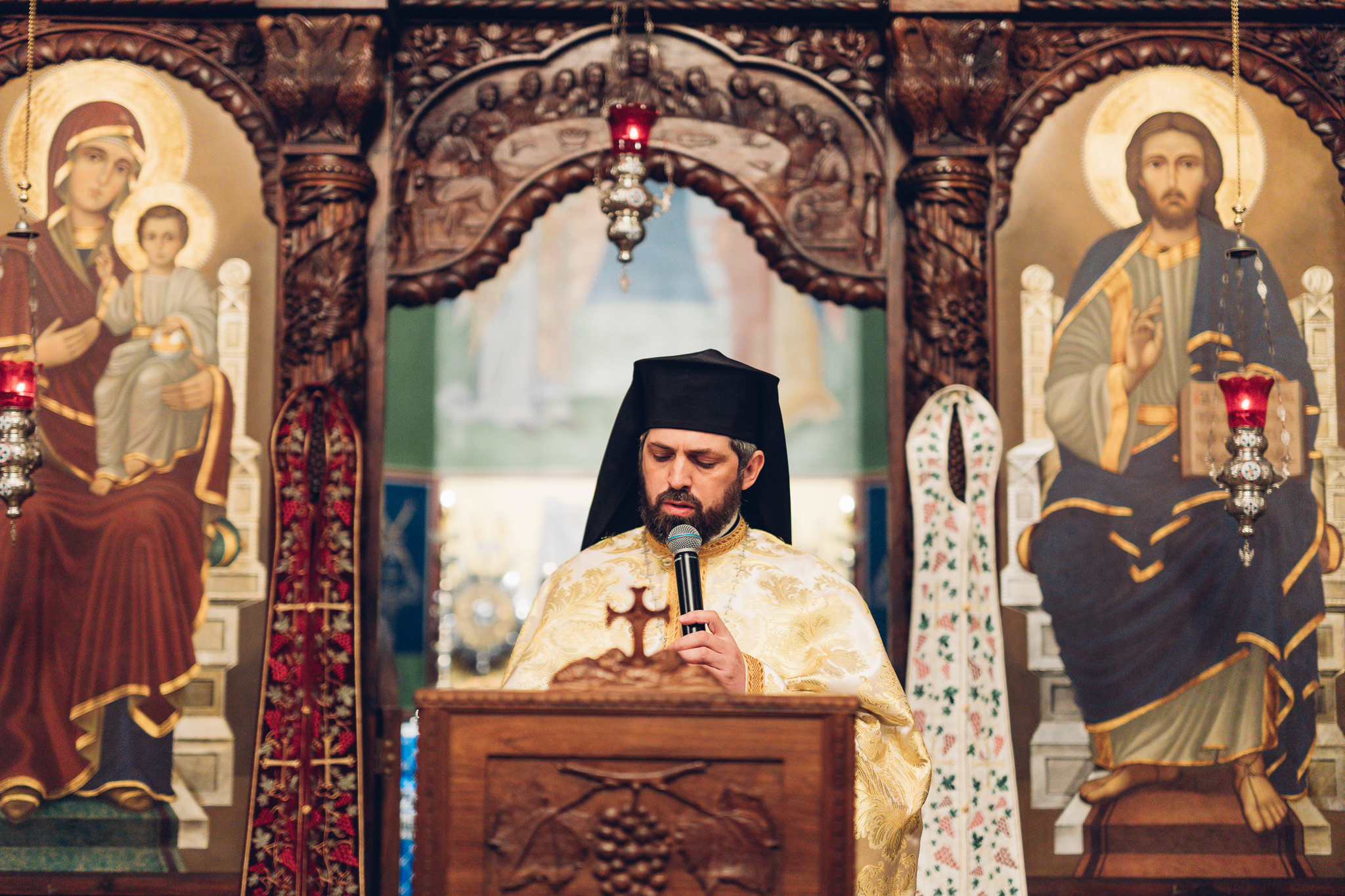
Parish priest at St. George Romanian Cathedral reads the Sunday of Orthodoxy Sermon
Orthodoxy is not merely an identity, nor simply a cultural inheritance, nor only a set of doctrines preserved in books. Orthodoxy is life—life in Christ, life in the Holy Spirit, life in the communion of the Church. It is a way of seeing, a way of loving, a way of being transformed.
The Fathers teach us that the goal of the Christian life is theosis—participation in the divine life. As the great Cappadocian Father St. Basil the Great wrote, “The human being is a creature commanded to become god.” This does not mean becoming divine by nature, but by grace: to be illumined by Christ, healed by His mercy, and conformed to His love.
Thus Orthodoxy is lived in prayer, fasting, repentance, and mercy. It is lived in the sanctification of time through the liturgical cycle, and of the senses through the veneration of holy things. It is lived in community—because no one is saved alone. The Church is not a federation of isolated believers, but the Body of Christ, where each member lives through the others and for the others.
This is why Pan-Orthodox worship is not an optional courtesy—it is a revelation of what the Church truly is. When we pray together across jurisdictions and languages, we manifest visibly what is already true invisibly: that we are one Church, one faith, one baptism, one Lord.
The Orthodox Church has always been incarnational. She takes root in peoples and cultures, speaks their language, sanctifies their customs, and baptizes their history. Yet she never becomes captive to ethnicity. The Church is not Greek or Serbian or Romanian or Arab or Canadian in essence; she is catholic—whole, universal, and all-embracing.
Already in the apostolic age, the Church crossed boundaries that seemed impossible. Jews and Gentiles, slaves and free, men and women, were united in one Eucharistic life. As St. Ignatius of Antioch proclaimed in the early second century: “Where Jesus Christ is, there is the catholic Church.”
Our gathering tonight stands in that same apostolic continuity. We honor our languages and traditions—they are gifts—but we refuse to let them become walls. The Orthodox Church does not erase diversity; she transfigures it. She does not demand uniformity; she creates communion.
This unity is especially precious in lands of diaspora such as Canada. Here, Orthodoxy is often experienced first through ethnic communities. This is natural and beautiful. But gatherings such as this Pan-Orthodox cycle remind us that our deeper identity is not national but ecclesial: we belong first to Christ, and through Him to one another.
The Sunday of Orthodoxy commemorates the restoration of the holy icons in 843, after long years of persecution and controversy. But the victory we celebrate is more than the permission to paint sacred images. It is the triumph of the truth that God truly became human—that matter can bear grace—that creation itself is called to transfiguration.
The defenders of icons understood that to reject the icon was to endanger the Incarnation itself. If Christ truly took flesh, then His human face can be depicted; if He can be depicted, He can be venerated; and if He can be venerated, matter itself becomes a bearer of divine presence.
The great defender of icons, St. John of Damascus, wrote: “I do not worship matter, but I worship the Creator of matter, who became matter for my sake.” In this luminous phrase we hear the entire theology of Orthodoxy: God enters creation so that creation may enter God.
Another champion of icons, St. Theodore the Studite, insisted that the icon safeguards the truth of salvation: “If Christ is not depictable, He is not incarnate; and if He is not incarnate, we are not saved.” Thus the restoration of icons is truly the restoration of the Gospel in visible form.
Tonight, as we stand before the holy icons in this church, we participate in that same triumph. Each icon around us silently proclaims: God is with us; the saints are alive; holiness is possible; the Kingdom is already among us.
Our gathering this evening is itself an icon—an icon of the unity of the Church. Just as many colors form one image, so many peoples form one Body. Just as different brushstrokes reveal one face of Christ, so different Orthodox traditions reveal one faith.
Pan-Orthodox services make visible what we confess in the Creed: “I believe in one, holy, catholic, and apostolic Church.” They remind us that the Eucharist celebrated in one parish is the same Eucharist everywhere; that the prayers chanted in different melodies ascend as one offering; that the saints venerated in different calendars rejoice in one communion.
The great theologian St. Maximus the Confessor described the Church as the place where all divisions are overcome in Christ: divisions of heaven and earth, soul and body, male and female, peoples and cultures. In Christ, he taught, multiplicity is not destroyed but harmonized.
This harmony is what we taste tonight. Clergy of different jurisdictions stand together; faithful of different backgrounds pray side by side. We may speak different mother tongues, but in prayer we share one language: the language of repentance, praise, and love.
That this Pan-Orthodox cycle begins in the season of Great Lent gives it special depth. Lent is a time when the Church intensifies her common life: more prayer, more fasting, more almsgiving, more reconciliation. It is the season when we rediscover that salvation is not private but communal.
Lent calls us to unity in several ways.
First, unity with God—through repentance. Every prostration we make acknowledges that we all stand equally in need of mercy.


Second, unity with one another—through forgiveness. We cannot approach the Paschal light while holding divisions in our hearts.
Third, unity in witness—through shared ascetic struggle. Whether Serbian or Greek, Romanian or Arab, we all abstain from the same foods, chant the same Lenten hymns, and journey toward the same Resurrection.
Pan-Orthodox prayer during Lent therefore reveals the Church at her most authentic: a people fasting together, praying together, hoping together.
Dear brothers and sisters,
The Windsor-Essex Pan-Orthodox cycle is not only an event; it is a calling. It calls us to deepen relationships across parish lines, to visit one another’s churches, to learn one another’s traditions, and above all to recognize Christ in one another.
When Orthodox Christians of different backgrounds truly know and love one another, the world sees something rare and radiant: unity without uniformity, diversity without division, tradition without isolation. This is a powerful witness in a fragmented society.
Let us therefore cherish these gatherings. Let us bring our children. Let us sing with full voice. Let us stand shoulder to shoulder. For in doing so we proclaim silently but unmistakably: Orthodoxy is alive; Orthodoxy is one; Orthodoxy is for all.
On this Sunday of Orthodoxy, we rejoice in the triumph of the holy icons, the victory of true faith, and the living unity of the Church. As we begin this Pan-Orthodox journey through the parishes of Windsor-Essex, may our common prayer strengthen our love, deepen our communion, and prepare us to greet the Resurrection with one heart and one voice.
Let us ask the Lord that our unity here on earth may reflect the unity of heaven; that our many languages may become one hymn; that our many traditions may reveal one faith; and that, through our shared Lenten pilgrimage, we may together behold the radiant glory of Pascha.
For truly, “how good and how pleasant it is for brethren to dwell together in unity.”
Amen.
V. Rev. Fr. Corneliu Andrasco
Parish priest at St. George Romanian Cathedral
Windsor, ON